These courses are listed by approved training centres. Please contact them directly regarding payments and availability queries.

Care Certificate Standard 16: Awareness of Learning Disability and Autism

CPD Certified Online Training Approved by Skills for Care

Care Certificate Standard 16: Awareness of Learning Disability and Autism at a glance

  • 99-year nationally recognised certificate
  • 1 hour and 11 minutes of engaging video training
  • Video access for 8 months
  • Printable wall certificate
  • CPD time credit conformation
  • Free weekly video refresher
  • Evidence Based Training certificate
Begin Online
Online Course: £10.00 + VAT

The Care Certificate Standard 16: Awareness of Learning Disability and Autism course is designed to help health and social care workers understand the unique needs, rights, and experiences of individuals with learning disabilities and autistic people. Introduced in 2025 as part of the updated Care Certificate framework, this training ensures staff are equipped to provide safe, inclusive, and person-centred care in line with CQC Regulation 18.

The course covers key topics such as the differences between learning disabilities and learning difficulties, characteristics of autism, effective communication strategies, and the importance of reasonable adjustments. It also explores relevant legislation, including the Mental Capacity Act and Equality Act, to support informed and respectful practice. By completing this training, staff demonstrate their commitment to delivering high-quality care that respects the dignity and individuality of neurodiverse people.

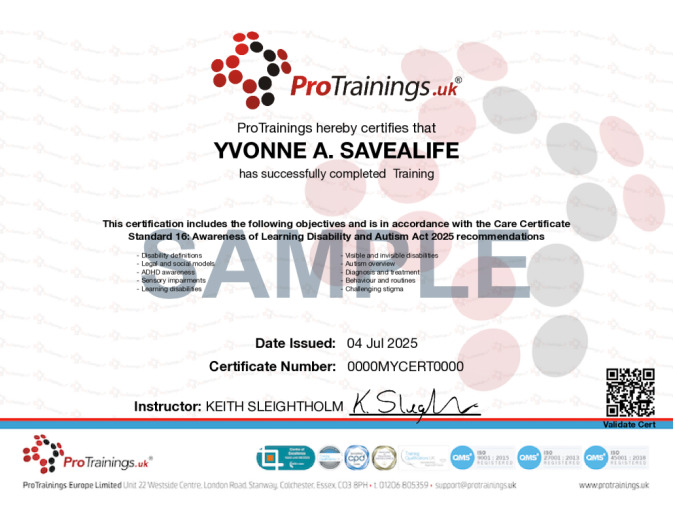
The content of this and all our courses has been independently certified as conforming to universally accepted Continuous Professional Development (CPD) guidelines and come with a Certified CPD Statement as well as a ProTrainings Certificate and for online courses an Evidence Based Learning statement.

 

  • Care assistants

  • Support workers

  • Community carers

  • Residential care staff

  • Health care assistants (HCAs)

  • Activity coordinators

  • Mental health support staff

  • Allied health assistants


This course comes with 2.0 hours of CPD, although the time to complete the course online may be less than this. Total course time includes 1 hours and 11 minutes of video training as well as knowledge reviews, final test, remedial help and reviewing downloaded material.

The content of this and all our courses has been independently certified as conforming to universally accepted Continuous Professional Development (CPD) guidelines and come with a Certified CPD Statement as well as a ProTrainings Certificate and for online courses an Evidence Based Learning statement.


  • Introduction

    • Icebreaker and participant introductions

    • Health and safety housekeeping

    • Why Standard 16 matters (e.g., rising prevalence, CQC Regulation 18, Oliver McGowan Training)

  • Key Definitions and Concepts

    • What is a learning disability?

    • What is autism and the autistic spectrum?

    • Common myths and stereotypes

  • Legal Frameworks

    • CQC Regulation 18

    • Equality Act 2010

    • Human Rights Act 1998

    • Duty of care

    • Oliver McGowan Mandatory Training

  • Learning Disabilities

    • Causes (genetic, perinatal, etc.)

    • Impact on daily life and independence

    • Severity and communication challenges

  • Support Strategies

    • Person-centred care

    • Promoting independence

    • Tailored support based on individual needs

  • Promoting Positive Attitudes

    • Reducing stigma and promoting inclusion

    • Building on strengths and abilities

  • The Social Model of Disability

    • Understanding barriers in society

    • Promoting independence through environmental and attitudinal change

  • Understanding Autism

    • Developmental aspects

    • Communication and sensory differences

    • Co-occurring behaviours (e.g., stereotypic behaviours)

  • Autism Spectrum Disorders

    • Overview of ASD types: Autistic Disorder, Asperger’s, Rett’s, CDD, PDD-NOS

    • Increase in diagnosis and environmental considerations

  • Communication Techniques

    • Clear and simple language

    • Visual aids and objects of reference

    • Observing non-verbal cues

  • Reasonable Adjustments

    • Adapting environments

    • Personalised care plans and routines

    • Use of communication tools

  • Practical Applications

    • Real-life scenarios (e.g., handling distress in noisy environments)

    • Documentation of care adaptations

  • Reflection and Assessment

    • Self-reflection questions

    • Knowledge check

  • Resources and Further Learning

    • Links to Oliver McGowan Training, NICE guidelines, Skills for Care resources