
- Course Library
- View all classroom courses
- Rail Trauma Level 2 (VTQ)™
Course Search
Browse by Topic
- First Aid
- First Aid in the Workplace
- Which FAW Course is right for me?
- CPR / BLS / ILS / ALS / AED
- Paediatric
- General Health and Safety
- Outdoor, Active Pursuits and Sports
- Pets / Animals
- Infection Control
- Marine / Boating Courses
- First Responder and Trauma
- Triage and Major Incident Planning and Support
- Scottish SQA Accreditations
- Office Skills
- Moving and Handling
- Risk Assessment
- Fire Safety
- Food Safety
- Health and Social Care
- Martyn's Law and Community Safety
- Care Certificate
- Medications
- Medical Procedures
- Medical Conditions
- Mental Health
- Office 365 and Computer Training
- Construction
- Confined Spaces and Working at Heights
- Transport
- Free and Funded Courses
- HR and General Employment
- Instructor
- ITG Instructor Training Courses
- citizenAID
- Partner Courses
- Other
- Regulated Qualifications
- International Course Versions
- Beauty
- Security
- Health and Fitness
- Emergency Planning
- View all online courses
- View all classroom courses
- Product Sites
Rail Trauma Level 2

Rail Trauma Level 2
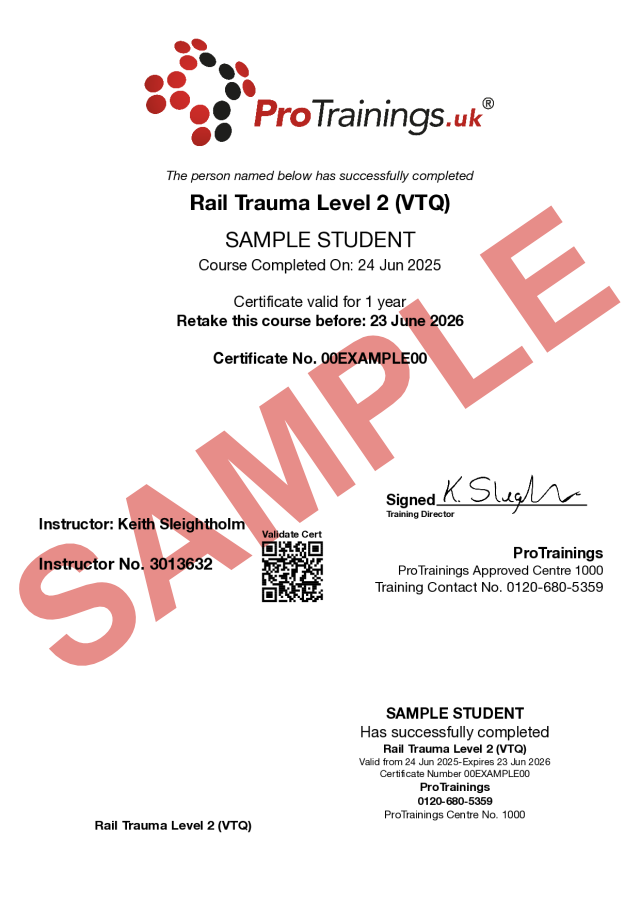
The content of this and all our courses has been independently certified as conforming to universally accepted Continuous Professional Development (CPD) guidelines and come with a Certified CPD Statement as well as a ProTrainings Certificate and for online courses an Evidence Based Learning statement.
1. Introduction and Course Administration
- Course objectives and format
- Housekeeping: fire exits, toilets, mobile phone policy
- Certification, CPD access, refresher training and ProTrainings dashboard
2. Importance of Bleeding Control
- Trauma as a leading cause of death under 40
- Haemorrhage statistics and importance of fast intervention
3. Physiology of Blood Clotting
- Clotting vs. anti-clotting chemicals
- Factors that prevent clotting (e.g. cold, medications)
- Coagulopathy definition and impact
4. Bleeding Severity and Classification
- Types of bleeding (arterial, venous, capillary)
- Life-threatening bleeds and catastrophic haemorrhage
- Haemorrhage classes (I–IV)
5. Catastrophic Haemorrhage
- Definitions and time-to-death based on arterial injury
- Practical significance for responders
6. First Aid Barriers and Safety
- Fear of action, glove use, avoiding contamination
- Latex allergy awareness and safe glove removal
7. Bleeding Control Techniques
- Direct pressure and proper placement
- Common problems with pressure dressings
- Layering issues and clotting factor displacement
8. Dressings and Haemostatic Agents
- Use of trauma dressings and haemostatic gauze
- WoundClot® Trauma Gauze: usage, benefits and application
9. Wound Packing
- Packing deep wounds with haemostatic gauze
- Emphasis on early emergency service activation
- Practical exercise: wound packing
10. Tourniquets
- Tourniquet definition and mechanism
- Commercial vs. improvised tourniquets (e.g. Tourni-Key)
- Application guidelines and safety
- Practical tourniquet application exercise
11. Electrical Incidents
- Effects of electrocution on the body
- Key “Do Not” actions for rescuers
- Safe removal techniques and treatment
- Call 999 and conduct primary survey
12. Recovery Position
- When and how to place someone safely in recovery
- Special considerations (e.g. pregnancy, vomiting)
13. Adult CPR (One Rescuer)
- CPR sequence: assess, compressions, breaths
- Compression depth, rate, and chest recoil importance
- Switch rescuers every 2 minutes for quality
14. AED Use
- Turning on and applying AED pads
- Following voice prompts
- Shock delivery and resumption of CPR
- Post-use cleaning and restocking
15. Post-Incident Stress
- Acknowledging responder stress
- Importance of debrief and asking for help
16. Emergency Kit Overview
- Life Saver Kit contents: tourniquets, gauze, dressings
- Firesafe Medical Kit with extinguisher and trauma kit
- Rapid deployment and design for emergencies
What is included in SUMO?
The Single Use Manikin Option (SUMO) is our revolutionary way of completing a fully-compliant blended course (online learning + hands-on skills evaluation) entirely from home. This price includes both the necessary SUMO manikin(s) and a skills evaluation with a certified ProTrainings Instructor via web conference.


